Architecture Technical Service - Download Catalog - Contact Us
Home
Products
Solutions
Finishes
Projects
Resources
Info
Video About

Perforated Wall Panels

Perforated wall panels combining acoustic performance with aesthetic appeal. Custom hole patterns, sizes, and arrangements for commercial and institutional wall applications.

Product Overview

Perforated Wall Panels

Ballesta perforated wall panels combine functional acoustic performance with creative aesthetic expression. Manufactured using turret punch press, CNC engraving, or laser cutting, our panels support unlimited hole patterns — from precision staggered arrays to custom graphic perforations. When combined with acoustic fleece backing, they deliver NRC ratings up to 0.80 while adding visual depth through light interaction.

Acoustic Performance

NRC ratings up to 0.80 with acoustic fleece backing. Open area from 10% to 40% targets specific frequency absorption. Micro-perforation (0.8-1.0mm) delivers solid-looking acoustic control for sensitive interiors.

Custom Pattern Designs

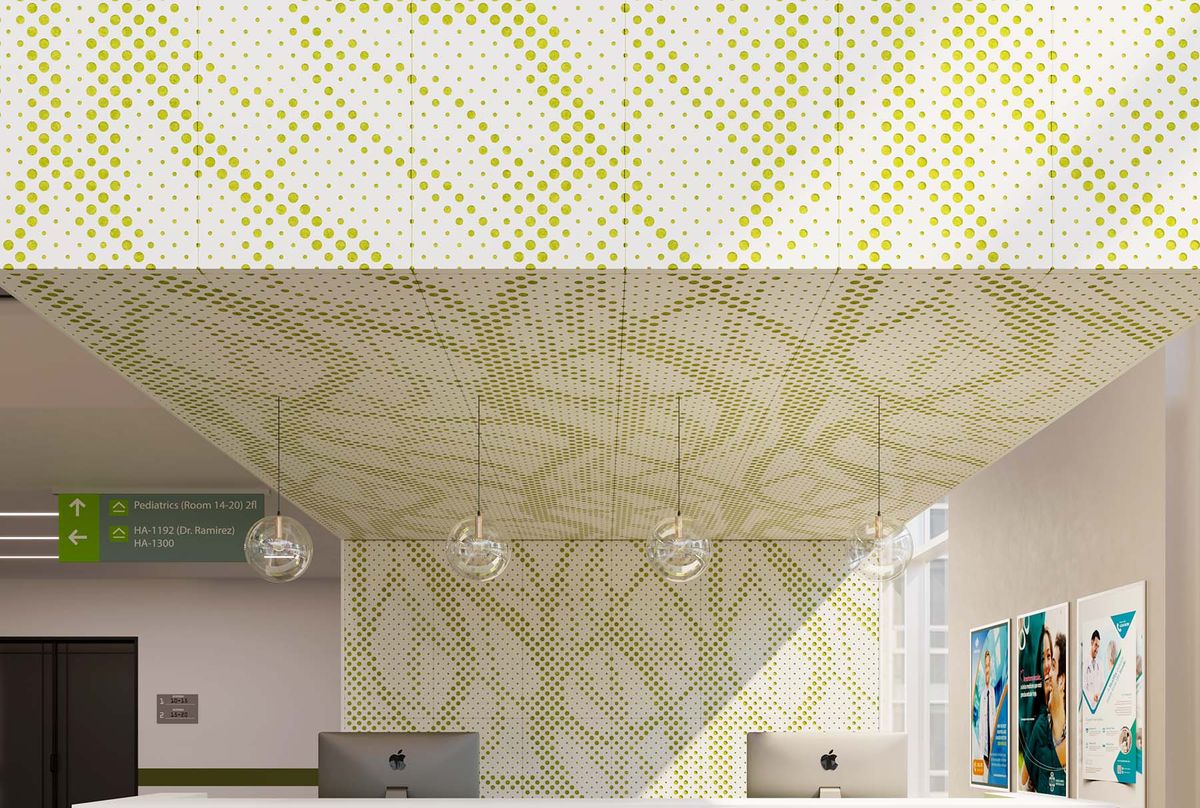
Straight row, staggered, gradient, fade, and unlimited custom graphics. CNC-controlled turret punching and laser cutting translate logos, text, and photographic images into precision perforation maps.

Multiple Manufacturing Technologies

Turret punch press (high volume), single-station punch (micro-perforation), CNC engraving (custom shapes), and fiber laser cutting (logo/graphic patterns). Each process selected for optimum quality and economy.

Two Perforation Levels

Standard perforation (1.8-3.0mm) and micro-perforation (0.8-1.0mm). Each level targets different acoustic and aesthetic requirements.

Engineering Integrity

Design rules ensure structural safety: hole diameter ≥ material thickness, edge distance ≥ material thickness. Stiffening ribs, L-channels, or honeycomb backing available for large-format panels with high open area.

Versatile Installation

Standard wall fixing or hook-on bracket systems. Large panels install efficiently. Back surface treatment available for open-back or double-sided installations where both faces are visible.

Manufacturing Process

Perforation Technologies

Ballesta employs multiple precision perforation technologies to produce hole patterns with exceptional accuracy and consistency. Each process is selected based on hole geometry, material thickness, production volume, and pattern complexity.

Turret Punch Press

High-speed turret punching is our primary production method for standard hole patterns. Multi-station turrets carry different punch-and-die sets for quick tool changes, enabling multiple hole sizes within a single panel without manual tool swaps. Ideal for high-volume runs with consistent hole diameters from 1.0mm to 10mm.

Best for: Large production volumes, standard round/square holes, consistent open area panels. Speed: up to 600 hits/min.

Single-Station Punch Press

For extended runs of a single hole pattern, dedicated single-station presses offer maximum throughput and tool life. The punch-and-die set is fixed, eliminating alignment variation between stations. Preferred for high-volume production of a single hole size where tool alignment precision is critical.

Best for: High-volume single-pattern runs, large-format panels, extended production campaigns.

CNC Engraving

Computer-controlled engraving removes material layer by layer to create non-round openings, tapered holes, multi-step cavities, and precise edge contours. This method is ideal for custom geometric patterns where punch tooling would be cost-prohibitive. Achieves tolerance of ±0.05mm.

Best for: Custom shapes, small-batch artistic patterns, prototype development. No minimum order quantity for CNC work.

Laser Cutting

Fiber laser cutting provides burr-free edges and the tightest positional accuracy for complex perforation graphics. Laser can cut virtually any hole shape — round, square, slot, teardrop, diamond, or custom logo outlines — without physical tooling. Heat-affected zone is minimized on aluminum.
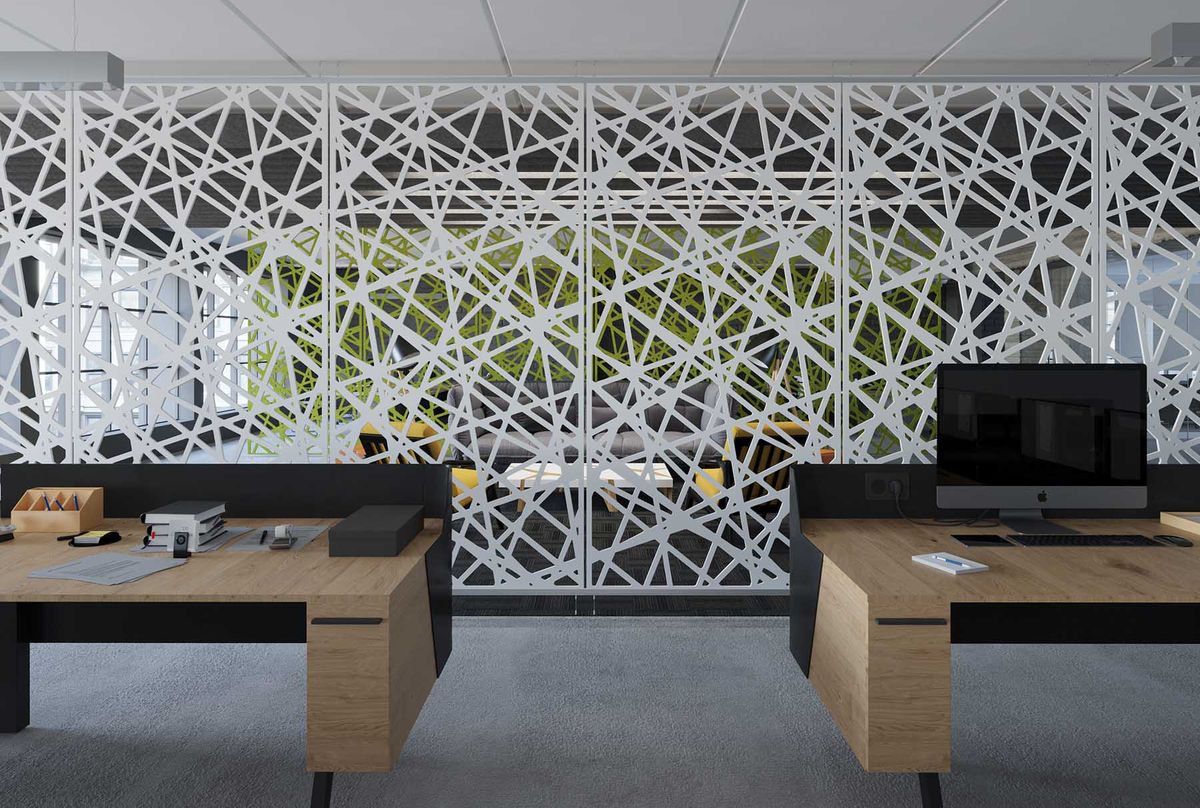
Best for: Logo perforation, image-mapped patterns, variable-size holes, small-batch custom designs. Kerf width: 0.1-0.2mm.
Ballesta turret punch press perforating aluminum wall panels
Turret punch press tooling changeover for multi-pattern perforation
Hole Patterns & Arrangements

Pattern Design Options

The arrangement, size, and shape of perforation holes determine both the acoustic performance and visual character of the finished wall panel. Ballesta offers unlimited pattern flexibility to match any architectural vision.

Straight Row

Holes aligned in uniform vertical and horizontal rows. Creates a clean, grid-like appearance suitable for minimal modern interiors. Open area is maximized for a given center distance, making this arrangement efficient for acoustic applications requiring high open area.

Staggered (Diamond)

Holes offset in alternating rows, creating a diamond/triangular arrangement. Staggered patterns provide the strongest panel structure for a given open area and are the most common choice for acoustic wall panels. This arrangement distributes stress evenly across the panel surface.

Custom Graphics

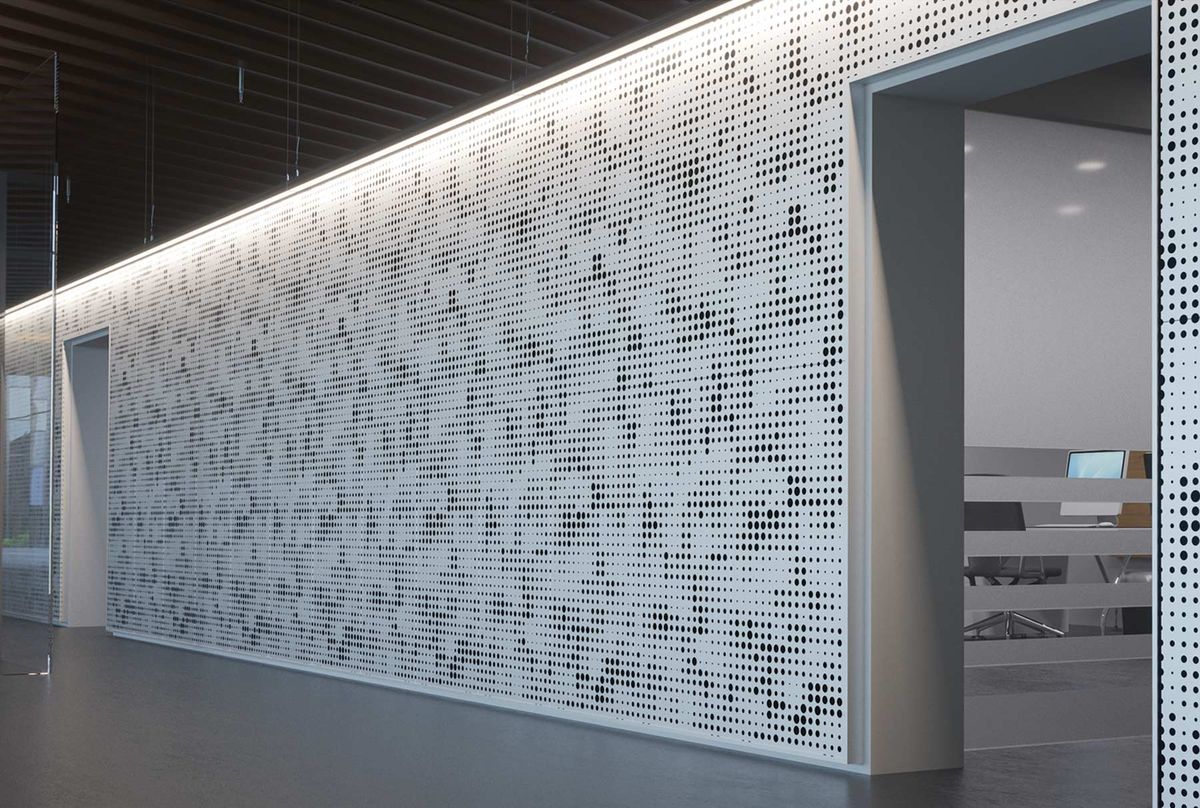
CNC-controlled perforation translates vector artwork, logos, text, or photographic images into hole maps. Hole size and density vary across the panel to create gradients, halftones, and figurative designs. Each hole becomes a pixel in the displayed image when backlit.

Round & Shaped Holes

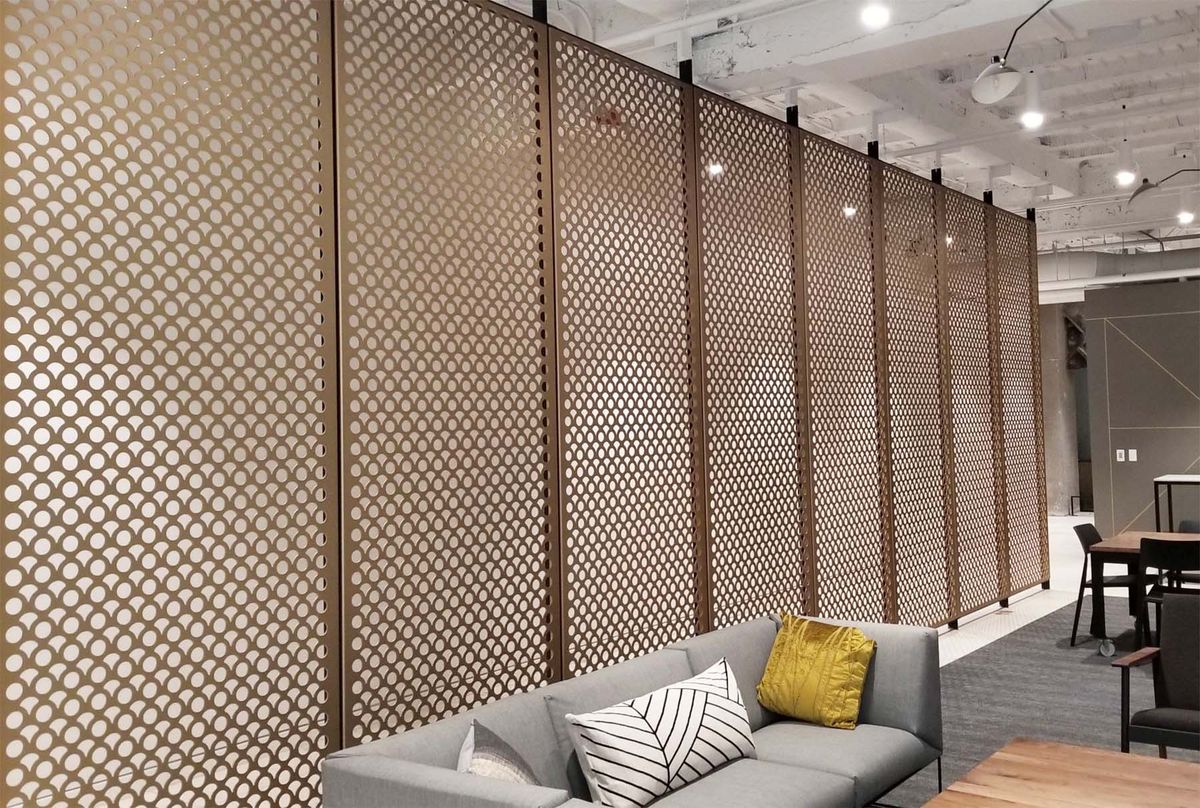
Round holes are the most common and cost-effective. Beyond round, Ballesta produces square, slot, diamond, teardrop, triangular, and custom-profile openings. Shaped holes add architectural character and can be arranged to form moiré patterns or directional textures.

Multi-Size Combinations

Large and small holes combined on a single panel create visual rhythm and depth. A common technique pairs larger perforations (3-5mm) for primary visual effect with finer perforations (0.8-1.0mm) for acoustic backing. The dual-scale approach maximizes both design and acoustic impact.

Gradient & Fade

Hole density or size gradually transitions across the panel surface, creating a fade effect from solid metal to fully perforated. Gradients can be linear, radial, or follow custom curves. This technique is frequently used for feature walls where the perforation blends into surrounding architecture.

Various perforated hole patterns and arrangements for architectural wall panels
Perforation pattern examples: staggered round, straight row slot, and custom graphic configurations
Engineering Constraints

Critical Design Rules

Perforated panel structural integrity depends on three fundamental design constraints. These rules ensure the panel retains sufficient strength after perforation and throughout its service life.

d ≥ t

Minimum Hole Diameter

Hole diameter must not be less than material thickness. For a 1.5mm panel, the minimum punchable hole diameter is 1.5mm. This rule applies to the smallest dimension of non-round holes as well. Punching holes smaller than material thickness risks punch breakage and edge cracking.

Example: 1.5mm panel → min hole ø = 1.5mm

e ≥ t

Minimum Edge Distance

The clear distance between the edge of any hole and the panel edge (or between two adjacent holes) must not be less than material thickness. Violating this constraint creates narrow webs of metal that can tear during punching or under load. For holes near panel edges, maintain at least 1.5x thickness for safety.

Example: 1.5mm panel → min edge distance = 1.5mm

t × A

Residual Strength

Open area percentage and panel thickness together determine residual panel strength. For load-bearing wall applications, we recommend open area ≤ 40% for 1.0mm panels, ≤ 50% for 1.5mm panels, and ≤ 60% for 2.0mm panels. Higher open areas require stiffening ribs or increased panel thickness.

Perforation reduces panel weight by up to 40%, lowering structural load

Open Area Calculation: The percentage of the panel surface removed by perforation. For round holes in a staggered pattern, open area = 90.7% × (d/p)², where d = hole diameter and p = center-to-center pitch. Standard open areas range from 10% to 40%. Higher open area increases sound absorption but reduces panel strength — our engineering team helps you find the optimal balance.

Structural Reinforcement

Stiffening Ribs & Back Treatment

For large-format perforated panels or applications with high open area, Ballesta engineers structural reinforcement solutions that maintain flatness and rigidity without compromising the visual perforation pattern.

Stiffening Ribs for Large Panels

Panels exceeding 1200mm in width or 2400mm in length may experience deflection under their own weight after perforation. Ballesta addresses this with integrated stiffening ribs — formed channels or L-profile reinforcements bonded or welded to the panel back face:

  • Formed ribs: The panel edge is folded 90° or shallow-pressed to create integral stiffening channels without adding separate components
  • Bonded L-channels: Aluminum L-profiles (typically 20×20mm or 30×30mm) attached with structural adhesive at regular intervals (600-900mm centers)
  • Honeycomb backing: For maximum flatness in premium applications, a 10mm or 15mm aluminum honeycomb core is bonded to the back face
  • Cross-bracing: Perimeter frame with internal cross supports for façade panels subject to wind load

All stiffening solutions are installed on the non-visible side and do not interfere with the perforation pattern visible to occupants.

Aluminum perforated wall panel with back stiffening ribs for flatness
Stiffening ribs bonded to the back face of a perforated wall panel
Back face treatment of perforated acoustic wall panels
Back surface finish treatment for visible-back applications

Back Surface Treatment

When perforated panels are used in free-standing dividers, open-back installations, or applications where the back face is visible, the back surface finish deserves equal attention:

  • Full-coverage finish: Both front and back receive identical powder coating or PVDF finish for a consistent appearance
  • Acoustic fleece laminated to back: Sound-absorbing fleece is thermally bonded to the back face, covering perforation holes. Fleece color can be selected (black, grey, white) to blend with the back view
  • Double-sided paint: For panels visible from both sides, we apply paint to both faces with matching color and gloss levels
  • Perforation burr removal: All panels undergo deburring to ensure clean hole edges on both front and back, preventing snagging and ensuring a smooth tactile surface
  • Anodized back: Natural anodized finish on the back when the visible front uses a painted finish — cost-effective without compromising the face appearance
Technical Specifications

Engineering Parameters

Complete technical data for Ballesta Acoustic Honeycomb Wall Panels. Custom dimensions and configurations available upon request.

Parameter Specification
MaterialAluminum AA1100, AA3003; Stainless Steel 304, 316
Panel Thickness1.0mm, 1.5mm, 2.0mm (aluminum); 0.8mm-1.0mm (stainless steel)
Hole Diameters1.0mm to 10mm (variable on same panel)
Open Area5% to 45% (up to 60% with stiffening ribs)
Min Hole DiameterD ≥ Material Thickness (punching rule: d ≥ t)
Min Edge DistanceClear distance between holes ≥ Material Thickness (e ≥ t)
Panel SizesCustom up to 1500mm x 4000mm
Pattern TypesStaggered, straight row, gradient, custom graphic, logo, image perforation, multi-size
Perforation TechnologiesTurret punch press, single-station punch press, CNC engraving, fiber laser cutting
Acoustic BackingAcoustic fleece, non-woven fabric, foam backing
FinishesPowder coating (RAL), PVDF, anodizing, wood grain, brushed
NRC RatingUp to 0.80 with acoustic fleece backing
Stiffening OptionsFormed ribs, bonded L-channels, honeycomb core (10/15mm), cross-bracing
Back TreatmentFull-coverage paint, acoustic fleece laminate, double-sided finish, deburred edges
Weight ReductionUp to 40% weight reduction vs. solid panel (at 40% open area)
Why Choose This Product

Six Key Advantages

Ballesta perforated wall panels deliver superior quality and performance for architectural wall cladding projects.

Artistic & Graphic Freedom

Create custom feature walls with perforation patterns forming logos, text, images, or abstract designs. Backlit perforations create dynamic depth. Laser cutting enables unlimited graphic complexity without tooling cost.

Superior Acoustics

Open area from 10% to 40% targets specific frequencies. Micro-perforated panels (0.8-1.0mm) achieve sound absorption while appearing nearly solid from a distance — ideal for high-end lobbies and auditoriums.

Light, Transparency & Ventilation

Perforation creates translucent effects for backlit feature walls and sunscreens. Open area allows natural air circulation through façades. Hole size and density control the balance between transparency, shading, and privacy.

Weight Reduction & Structural Design

Up to 40% weight reduction vs. solid panels lowers structural load. Engineered stiffening ribs and honeycomb backing maintain flatness even at high open areas. Ideal for large-format architectural cladding.

Rain Screen & Solar Shading

Perforated panels function as rain screen cladding and solar shading devices. Open area allows pressure equalization and drainage while controlling solar heat gain. Extended hole patterns create dynamic exterior façades.

Eco-Friendly & Sustainable

Aluminum is 100% recyclable. Perforation reduces raw material usage. Optimized nesting minimizes scrap. Lightweight panels reduce transportation carbon footprint.

Applications

Ideal for Premium Spaces

Ballesta perforated wall panels are specified across a wide range of noise-sensitive environments requiring superior flatness and acoustic performance.

Performance Halls
Office Buildings
Retail Malls
Hotel Lobbies
Conference Rooms
Airport Terminals
Metro Stations
Hospital Corridors
School Classrooms
Shopping Centers
Data Centers
Recording Studios
Cultural Venues
Sporting Arenas
Downloads

Technical Resources

Download technical datasheets and catalogs for our acoustic honeycomb wall panels.

FAQ

Frequently Asked Questions

What hole sizes and patterns are available?

1.0mm to 10mm in round, square, slot, diamond, and custom shapes. Patterns include straight row, staggered (diamond), gradient, fade, multi-size combinations, and CNC-controlled graphic perforation for logos and images. Hole diameter must not be less than material thickness per our engineering design rules.

What manufacturing processes do you use?

We use three complementary technologies: turret punch press (high-volume standard patterns), CNC engraving (custom non-round shapes, prototypes), and fiber laser cutting (logo/graphic patterns, burr-free edges, no tooling cost).

What are the design constraints for perforated panels?

Two critical rules: (1) Hole diameter must equal or exceed material thickness — e.g., 1.5mm panel requires min 1.5mm hole diameter. (2) Clear distance between hole edges (or hole edge to panel edge) must equal or exceed material thickness. These rules prevent punch breakage and panel edge tearing. Higher open area panels may require stiffening ribs.

NRC ratings achievable?

Standard perforation (2.0-5.0mm, 20-30% open area) with fleece achieves NRC 0.60-0.80. Micro-perforated panels (0.8-1.0mm) with fleece achieve NRC 0.50-0.70. We provide acoustic calculations for specific hole patterns and space requirements.

erforated panels (0.8-1.0mm) with fleece achieve NRC 0.50-0.70. We provide acoustic calculations for specific hole patterns and space requirements.

Can you make large perforated panels with high open area?

Yes. For panels exceeding 1200mm width or 2400mm length, we add stiffening ribs (formed channels or bonded L-profiles) to maintain flatness. For maximum rigidity and flatness, aluminum honeycomb core (10-15mm) can be bonded to the back face. Open area above 40% generally requires reinforcement.

What back surface treatment options exist?

For panels visible from both sides (free-standing dividers, open-back installations), we offer full-coverage paint on both faces with matching color and gloss levels. Acoustic fleece can be laminated to the back in multiple colors. All panels undergo deburring to ensure clean edges on both sides.

Exterior and rain screen use?

Yes for covered exterior, rain screen cladding, and sunscreens with weather-resistant finishes (PVDF or durable powder coating). Perforated panels function as rain screens with pressure equalization and drainage. Larger holes (3mm+) recommended for fully exposed use to prevent clogging.

Custom logo or graphic perforation?

Yes. Laser cutting and CNC-controlled turret perforation can produce any pattern with unlimited complexity. Vector artwork (AI, PDF, DWG) is preferred for best resolution; high-resolution raster accepted. Prototype sample recommended for approval before production.

Need a Perforated Wall Panels Solution?

Contact our technical team for project-specific recommendations, samples, and competitive pricing. We respond within 24 hours.

Get a Quote
WhatsApp Call